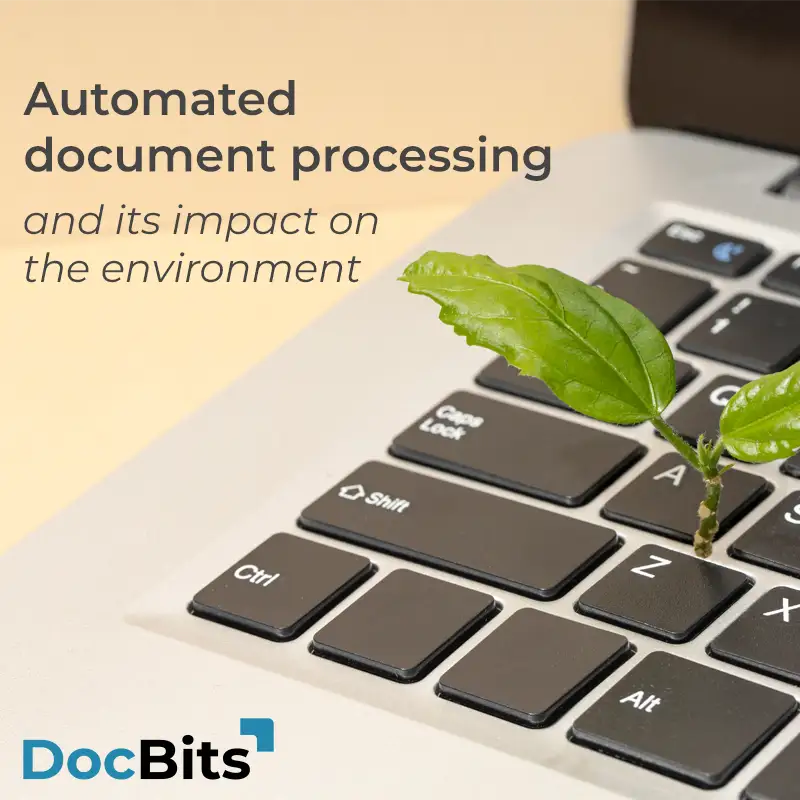

Imagine if you could save tons of paper every day, drastically reduce energy consumption and at the same time raise the efficiency of your business processes to a new level. Sounds too good to be true? Welcome to the world of automated document processing—a technology that can not only revolutionize your business, but also make a significant contribution to environmental protection.
Discover how DocBits, our innovative intelligent document processing (IDP) platform, is changing the way we handle documents and protecting the environment in the process. Let’s take a look together at how document automation is shaping the future of corporate sustainability.
Traditional document processing is resource-intensive. From printing and copying to archiving—paper consumption and energy use are enormous. You might think that global paper consumption has been declining since the advent of the internet, but this assumption is deceptive.
According to FAO (Food and Agriculture Organization) data published by WWF Germany, around 130 million tons of paper were produced and consumed around the world in 1970. By 2005, this figure had risen to 367 million tons. The most recent FAO data shows global paper and paperboard production at 401 million tons in 2023. The associated energy consumption and CO2 emissions are considerable. In addition, paper production contributes to deforestation, which has negative consequences for biodiversity and the climate.
The hidden costs of paper-based processes extend beyond environmental damage:
The shift from paper to digital document processing delivers measurable environmental benefits. Here’s what peer-reviewed research and industry studies show for businesses that implement intelligent document processing:
Paper Consumption Reduction A mid-sized company processing 10,000 invoices annually consumes approximately 50,000 sheets of paper per year (accounting for copies, reprints, and filing). By automating invoice processing with IDP, businesses eliminate 80-95% of this paper use—saving roughly 40,000-47,500 sheets annually.
For context:
igital document storage and processing consumes significantly less energy than maintaining physical archives. Traditional filing systems require:
Research shows that dematerialization through document automation reduces energy consumption by 30-60%, depending on the sector and specific implementation (ADEME, French Environment Agency).
Peer-reviewed research from Aalto University (Tenhunen & Penttinen, ACIS 2010) demonstrates that switching from paper to electronic invoicing reduces lifecycle CO2 emissions by 63% per invoice. This finding has been corroborated by UNCTAD and UN ESCAP studies.
For a company processing 10,000 invoices per year with 95% digitalization:
Recent research on agentic AI document processing (Pasquadibisceglie et al., arXiv:2511.07097, 2025) reports even higher reductions: 90-97% CO2 reduction for fully automated AI workflows processing 5,000 documents daily, demonstrating the upper-bound potential of advanced IDP systems.
Paper production is water-intensive. According to research by Mekonnen & Hoekstra (Water Resources Management, Springer 2011), printing and writing paper requires 2-13 liters of water per A4 sheet when accounting for the full water footprint (including forestry). Using a conservative median estimate of 7 liters per sheet:
A business processing 10,000 invoices annually (47,500 sheets with copies/filing) saves approximately 330,000 liters of water per year by going paperless.
Transportation Emissions Traditional document workflows often involve:
Intelligent document processing with supplier portals and digital approval workflows eliminates these transportation emissions entirely. Switzerland’s “Sustainability in Invoicing 2023” study found that paper invoicing generates 25g CO2e per invoice—reaching 50% digital adoption would cut total invoicing emissions by approximately 54%.
Automated document processing drastically reduces the need for physical paper and associated processes. By using digital technologies like intelligent document processing (IDP), documents can be created, processed and stored more efficiently. This leads to a significant reduction in paper consumption and the associated environmental impact.
Modern IDP platforms go beyond simple digitization. They leverage artificial intelligence to:
The result is a paperless office that operates faster, more accurately, and with dramatically lower environmental impact than traditional processes.
This is where DocBits comes into play—our innovative software solution for automated document processing. DocBits offers companies an intelligent platform to fully digitize and automate their document processes. But how exactly does DocBits help to protect the environment?
Reduction of paper consumption By digitizing document processes, DocBits reduces the need for printed documents. This conserves natural resources and decreases your company’s ecological footprint. DocBits processes invoices, purchase orders, order confirmations, and handwritten forms entirely digitally—eliminating paper from the workflow.
Energy savings Automated processes are more energy efficient than manual processes. DocBits minimizes energy consumption by eliminating redundant tasks and maximizing the efficiency of document processing. Native ERP integrations with Infor LN, Infor M3, Infor CloudSuite, and SAP ensure data flows seamlessly without manual intervention.
Optimized resource management DocBits enables efficient management and processing of documents in the cloud, which reduces physical storage resources and the associated energy consumption. Documents are archived in secure, compliant digital repositories accessible instantly without the environmental cost of physical retrieval.
Improved efficiency By automating time-consuming document processes, companies not only save resources but also time. This leads to higher productivity and more sustainable use of available resources. DocBits’ AI-powered features like Auto Accounting, PO Matching, and AI Agents eliminate manual data entry entirely.
Supplier Portal for sustainable collaboration DocBits’ Supplier Portal enables vendors to submit invoices digitally directly into your system—cutting out paper, postal services, and courier emissions from the start. This collaborative approach extends sustainability benefits across your entire supply chain.
Environmental, Social, and Governance (ESG) reporting has become a critical requirement for businesses—particularly in the European Union with the introduction of the Corporate Sustainability Reporting Directive (CSRD).
EU CSRD Requirements The CSRD mandates that companies report on their environmental impact under the European Sustainability Reporting Standards (ESRS), including:
Document automation directly impacts Scope 3 emissions by reducing:
Important 2026 Update: In February 2026, the EU Council adopted the Omnibus I simplification package (Directive (EU) 2026/470), which the European Commission states will “remove around 80% of companies from the scope of the CSRD.” National transposition is required by March 2027. Companies should verify current threshold requirements with their legal advisors.
How DocBits Delivers ESG Data Intelligent document processing platforms like DocBits provide quantifiable metrics for sustainability reporting:
These metrics can be integrated directly into ESG reports, tender responses, and corporate sustainability communications.
Tender and RFP Support Large enterprises—especially in the EU—increasingly include ESG criteria in procurement tenders. Companies using DocBits can demonstrate:
For procurement teams responding to RFPs, DocBits provides the data and documentation to substantiate environmental claims.
Understanding the environmental return on investment (ROI) of intelligent document processing helps businesses quantify their sustainability impact.
Basic Environmental ROI Formula:
For a company processing X invoices per month:
Paper Saved:
CO2 Reduction:
Trees Saved:
Water Saved:
Example: Company processing 1,000 invoices/month
For organizations processing tens of thousands of documents annually, these numbers scale significantly—delivering measurable environmental impact alongside operational efficiency.
Switching to automated document processing is a significant step towards sustainability. Companies that use technologies like DocBits not only benefit from increased efficiency and cost savings, but also make a valuable contribution to environmental protection.
By replacing traditional paper-based processes with innovative software solutions like DocBits, together we can create a more sustainable future. The environmental benefits are clear:
Beyond environmental impact, intelligent document processing supports broader ESG goals by providing quantifiable sustainability data for corporate reporting, tender responses, and stakeholder communications.
If you would like to find out more about DocBits and its environmental benefits, please contact us or book a free, no-obligation demo with our experts. Together we can revolutionize your document processes and protect the environment at the same time.
Yes. Peer-reviewed research demonstrates that paperless offices reduce lifecycle CO2 emissions by 63% per document (Aalto University study, Tenhunen & Penttinen, ACIS 2010), eliminate 80-95% of paper waste, and cut energy consumption by 30-60% across document workflows (ADEME).
The environmental benefits extend across the entire document lifecycle—from production and transportation to storage and disposal. Intelligent document processing platforms like DocBits enable businesses to achieve these reductions while improving operational efficiency and accuracy.
For a mid-sized company processing 10,000 invoices per year with 95% digitalization, automated document processing saves approximately 285 kg of CO2 annually—equivalent to driving 2,670 km in an average EU car (based on 2024 EU average emissions of 106.8g CO2/km). This reduction comes from eliminating paper production (which generates 1.2 kg CO2 per kg of paper using conservative lifecycle assessment figures), reducing energy consumption in storage facilities, and cutting transportation emissions from document courier services.
Advanced agentic AI document workflows can achieve even higher reductions—up to 90-97% according to recent research (Pasquadibisceglie et al., arXiv:2511.07097, 2025).
The energy comparison between digital and paper storage depends heavily on implementation and usage patterns. Digital document storage eliminates the need for climate-controlled physical facilities, lighting for retrieval, and transportation to off-site archives. Research shows that dematerialization through document automation reduces overall energy consumption by 30-60% depending on the sector (ADEME, French Environment Agency). However, modern data centers—while energy-intensive in absolute terms—store vastly more documents per unit of energy than physical archives.
Cloud-based IDP platforms like DocBits optimize energy efficiency through modern infrastructure and eliminate the ongoing operational energy requirements of maintaining, heating, cooling, and accessing physical filing systems.
The top three environmental benefits of intelligent document processing are: (1) 80-95% reduction in paper consumption, eliminating trees, water, and energy used in paper production; (2) 63% lifecycle CO2 reduction per document (peer-reviewed research from Aalto University), achieved by replacing paper production, printing, and transportation; (3) 30-60% lower energy consumption from digitizing document workflows and eliminating physical archives.
Additional benefits include reduced water usage (paper production requires 2-13 liters per sheet including forestry water footprint), decreased waste in landfills, and elimination of courier transportation emissions. Advanced AI-powered IDP systems can achieve even higher environmental savings—up to 90-97% CO2 reduction for fully automated workflows.
Intelligent document processing platforms like DocBits provide quantifiable environmental data that supports ESG (Environmental, Social, and Governance) reporting requirements—particularly under frameworks like the EU’s Corporate Sustainability Reporting Directive (CSRD). IDP systems track the number of documents processed digitally, calculate paper and CO2 savings, measure energy reductions, and capture supplier sustainability data during invoice processing.
These metrics can be integrated directly into ESG reports, tender responses, and corporate sustainability communications, demonstrating measurable Scope 3 emissions reductions across the value chain (Category 1: purchased goods and services; Category 4: upstream transportation). Note: The EU adopted the Omnibus I simplification package in February 2026, which significantly narrows CSRD’s scope—companies should verify current threshold requirements with legal advisors.
Yes. Large enterprises—especially in the European Union—increasingly include ESG criteria in procurement tenders and requests for proposal (RFPs). Companies using intelligent document processing can demonstrate measurable environmental impact reduction, digital-first operational processes, compliance with sustainability reporting standards, and commitment to continuous improvement in resource efficiency.
DocBits users can quantify their paper consumption reduction, CO2 savings, and energy efficiency improvements to support tender responses with concrete sustainability data. Based on peer-reviewed research (63% lifecycle CO2 reduction per document, Aalto University) and verified industry benchmarks, IDP provides the documentation needed to meet sustainability requirements in competitive procurement processes.
Schedule a free demo and bring your own documents — see DocBits process them live.
Image credits: Header- & featured image by freepik
Sources:
Share:
You are currently viewing a placeholder content from Vimeo. To access the actual content, click the button below. Please note that doing so will share data with third-party providers.
More InformationYou are currently viewing a placeholder content from YouTube. To access the actual content, click the button below. Please note that doing so will share data with third-party providers.
More InformationYou need to load content from reCAPTCHA to submit the form. Please note that doing so will share data with third-party providers.
More InformationYou are currently viewing a placeholder content from Vimeo. To access the actual content, click the button below. Please note that doing so will share data with third-party providers.
More InformationYou are currently viewing a placeholder content from YouTube. To access the actual content, click the button below. Please note that doing so will share data with third-party providers.
More InformationYou are currently viewing a placeholder content from Bunny Stream. To access the actual content, click the button below. Please note that doing so will share data with third-party providers.
More InformationYou are currently viewing a placeholder content from Wistia. To access the actual content, click the button below. Please note that doing so will share data with third-party providers.
More InformationYou are currently viewing a placeholder content from Facebook. To access the actual content, click the button below. Please note that doing so will share data with third-party providers.
More InformationYou are currently viewing a placeholder content from Instagram. To access the actual content, click the button below. Please note that doing so will share data with third-party providers.
More InformationYou are currently viewing a placeholder content from X. To access the actual content, click the button below. Please note that doing so will share data with third-party providers.
More Information