















Your suppliers send XRechnung, ZUGFeRD, PEPPOL and more. DocBits receives, validates and forwards every e-invoice to your ERP automatically — format-ready, compliance-ready, every time.
E-invoicing mandates are rolling out across Europe. Germany requires XRechnung and ZUGFeRD. Cross-border transactions run on PEPPOL. Italian suppliers send FatturaPA. Swiss partners use QR invoices.
Each format has its own structure, schema version, and validation rules. And your ERP doesn’t just accept them as-is — someone has to map the data, check it, and get it into the system.
If your team is doing that manually — or if your current process only handles one or two formats — you already know the problem: bottlenecks, errors, and compliance risk that grows every time a new mandate kicks in.
DocBits handles the full e-invoice processing cycle for you:
XRechnung, ZUGFeRD, PEPPOL BIS Billing 3.0, FatturaPA, Swiss QR Code, EDI — and processes it according to its specific schema. No manual sorting, no format-by-format configuration.
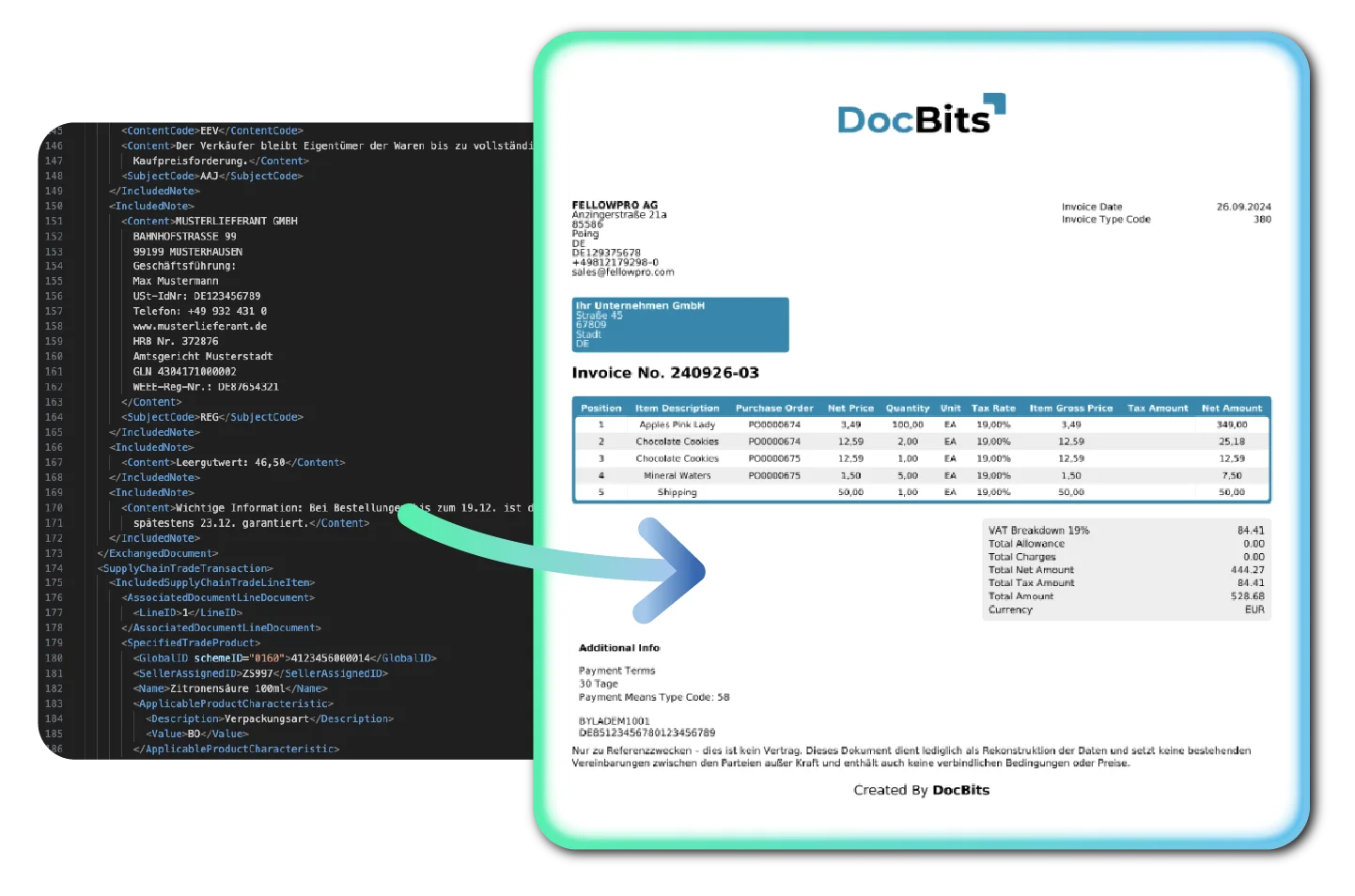
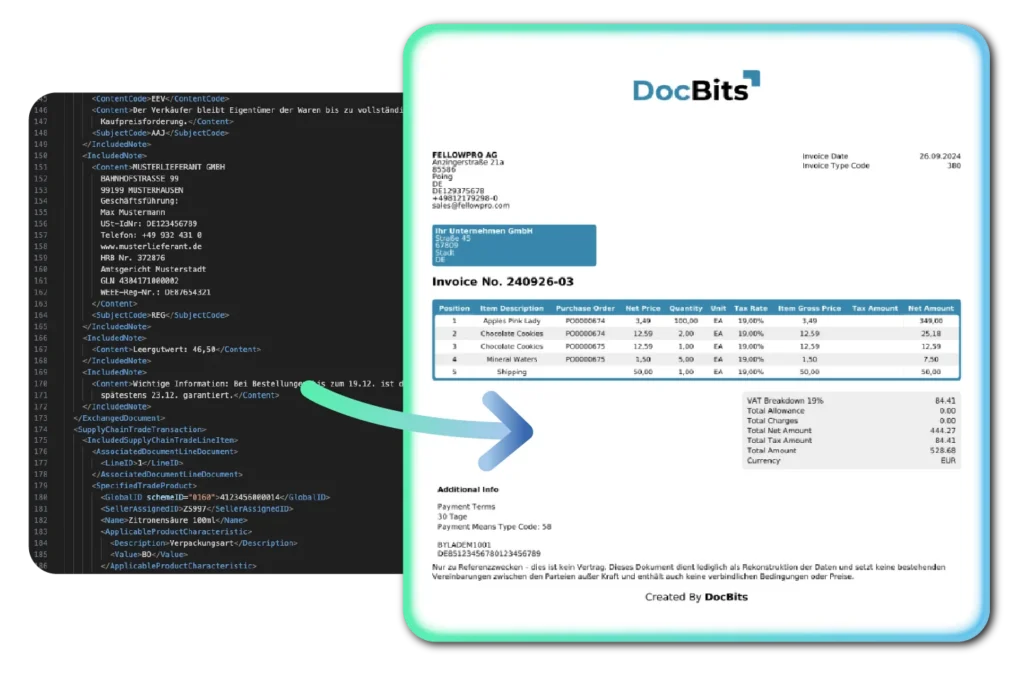
Unlike scanned PDF invoices, structured e-invoices carry machine-readable XML data. DocBits reads that data directly — meaning extraction accuracy is not dependent on scan quality, font, or layout. What’s in the XML is what goes into your ERP.
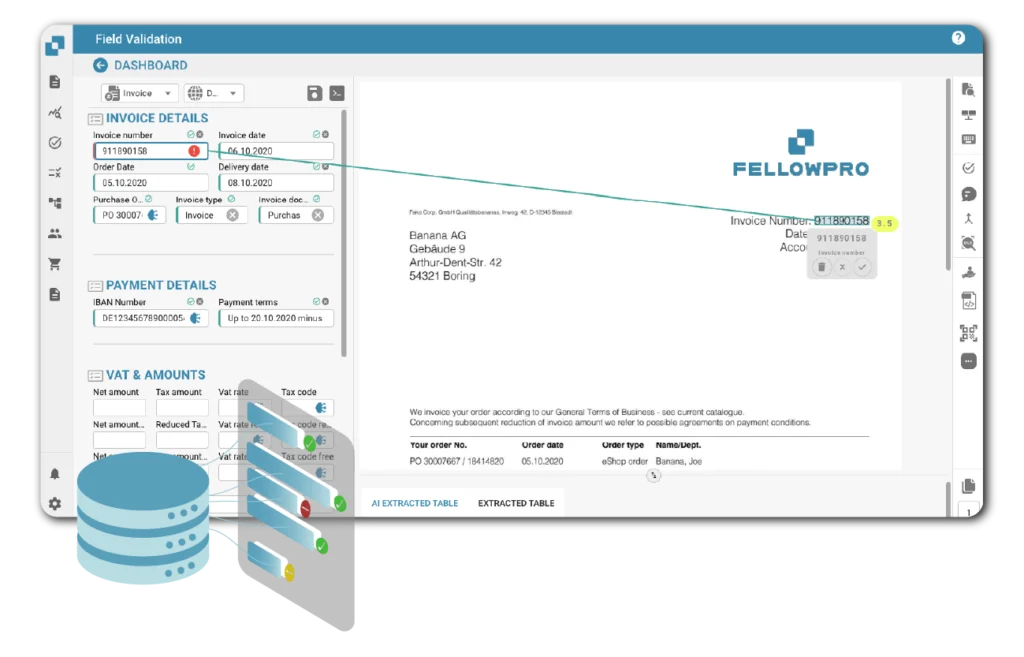
DocBits validates the extracted data against your ERP master data: vendor records, cost centers, PO references, GL accounts. Mismatches are flagged for review — not silently passed through.
DocBits currently supports:
A European network and infrastructure that enables companies and public administrations to exchange electronic invoices and other documents in a standardized and secure manner.
Standard format in Germany for electronic invoices to public clients. It is XML-based and complies with the European standard EN 16931.
A hybrid format that contains both a structured XML file and a visually readable PDF file. It combines the advantages of both formats.
The official format for electronic invoices in Italy, which is mandatory for invoicing to the public administration. It is transmitted in XML format.
A component of the Swiss QR-bill system. It contains all the necessary invoice information in a QR code, which facilitates machine-readable processing.
Most e-invoicing tools work fine in isolation. The problem starts when they have to talk to your ERP.
Generic solutions require custom field mappings, middleware, and ongoing maintenance every time your ERP setup changes. That’s an IT project — not a day-one solution.
DocBits was built from the ground up for ERP integration:
DocBits connects directly to your ERP without connectors or translation layers. E-invoice data is mapped to Infor's native field structure — vendor master, cost center, PO reference, GL account — and forwarded ready to post.
Incoming e-invoices are automatically matched against open purchase orders — down to individual line items, quantities, and prices. Matched invoices move forward without manual intervention. Exceptions are flagged clearly.
DocBits doesn't replace your existing approval process. After validation and matching, invoices follow your configured workflow — whether that's a two-step approval, department routing, or exception-only review. Your team only sees what needs attention.
DocBits, trusted by companies around the world
E-invoicing handles structured incoming invoices. But your accounts payable process doesn’t stop there — cost invoices, purchase orders, delivery notes, and approval workflows are part of the same chain.
DocBits connects all of it:
One platform. One integration. Every document type.
Yes. Dedicated e-invoice processing software receives structured electronic invoices — in formats like XRechnung, ZUGFeRD, or PEPPOL — reads the machine-readable data directly, validates it against your ERP master data, and forwards it for posting. The entire cycle runs without manual data entry. Solutions like DocBits connect natively to ERP systems such as Infor and SAP, so no custom middleware is needed.
Yes, and the root cause is usually a missing processing layer between your incoming invoices and your ERP. E-invoices in structured formats like XRechnung or ZUGFeRD already contain all the data in machine-readable form — they don’t need to be re-entered manually. An e-invoice processing solution reads that data directly, validates it, and posts it to your ERP automatically. Your team only needs to handle exceptions, not routine entries.
Companies that receive e-invoices from multiple countries typically use a central processing platform that supports all major formats — XRechnung (Germany), PEPPOL BIS Billing (EU cross-border), ZUGFeRD (Germany), FatturaPA (Italy), and others. The platform detects the format automatically, extracts the data, and routes it into the ERP system without format-by-format manual handling. This is especially relevant for European companies with suppliers in multiple countries, where different national mandates result in different incoming formats.
The strongest solutions combine broad format support (XRechnung, ZUGFeRD, PEPPOL, FatturaPA), native ERP integration without custom middleware, and data validation before posting. DocBits connects directly to Infor LN, Infor CloudSuite, and SAP with pre-built field mappings — no IT project required.
Look for a platform that automatically detects the incoming format — XRechnung, ZUGFeRD, PEPPOL, FatturaPA, Swiss QR Code — and processes each according to its schema without separate configurations. DocBits handles all major European e-invoice formats in a single workflow and adds new formats as regional mandates expand.
DocBits supports XRechnung (UBL 1.2, 2.1, 3.0), ZUGFeRD (1.0, 2.1, 2.3), PEPPOL BIS Billing 3.0, Factur-X Basic, FatturaPA, Swiss QR Code, and EDI formats. Schema versions are detected and handled automatically. New formats are added as regional mandates expand.
DocBits integrates natively with Infor LN and Infor CloudSuite — no changes to your ERP configuration, no custom development. Field mappings, approval workflows, and posting rules stay exactly as they are. Your team is up and running without disruption.
You are currently viewing a placeholder content from Vimeo. To access the actual content, click the button below. Please note that doing so will share data with third-party providers.
More InformationYou are currently viewing a placeholder content from YouTube. To access the actual content, click the button below. Please note that doing so will share data with third-party providers.
More InformationYou need to load content from reCAPTCHA to submit the form. Please note that doing so will share data with third-party providers.
More InformationYou are currently viewing a placeholder content from Vimeo. To access the actual content, click the button below. Please note that doing so will share data with third-party providers.
More InformationYou are currently viewing a placeholder content from YouTube. To access the actual content, click the button below. Please note that doing so will share data with third-party providers.
More InformationYou are currently viewing a placeholder content from Bunny Stream. To access the actual content, click the button below. Please note that doing so will share data with third-party providers.
More InformationYou are currently viewing a placeholder content from Wistia. To access the actual content, click the button below. Please note that doing so will share data with third-party providers.
More InformationYou are currently viewing a placeholder content from Facebook. To access the actual content, click the button below. Please note that doing so will share data with third-party providers.
More InformationYou are currently viewing a placeholder content from Instagram. To access the actual content, click the button below. Please note that doing so will share data with third-party providers.
More InformationYou are currently viewing a placeholder content from X. To access the actual content, click the button below. Please note that doing so will share data with third-party providers.
More Information